obrienk

Tuesday, November 19, 2019

Cal Newport on Deep Work and Digital Minimalism

Lately, I have been obsessed with the wisdom of Cal Newport.

After recently reading...

Atomic Habits: An Easy & Proven Way to Build Good Habits & Break Bad Ones by James Clear


I have revisited Cal Newport's books, especially DEEP WORK: Rules for Focused Success in a Distracted World. 
Here's a brief summary.

Cal Newport first came onto my radar via his TED Talk:

You probably don't realize that right now, you're actually looking at something quite rare. Because I am a millennial computer scientist book author standing on a TEDx stage, and yet, I've never had a social media account. How this happened was actually somewhat random. Social media first came onto my radar when I was at college, my sophomore year of college, this is when Facebook arrived at our campus. And at the time, which was right after the first dotcom bust, I had had a dorm room business, I'd had to shut it down in the bust, and then, suddenly, this other kid from Harvard, named Mark, had this product called Facebook and people being excited about it. So in sort of a fit of somewhat immature professional jealousy, I said, "I'm not going to use this thing. I won't help this kid's business; whatever's going to amount to." As I go along my life, I look up not long later, and I see everyone I know is hooked on this thing. And from the clarity you can get when you have some objectivity, some perspective on it, I realized this seems a little bit dangerous. So I never signed up. I've never had a social media account since. So I'm here for two reasons; I want to deliver two messages. The first message I want to deliver is that even though I've never had a social media account, I'm OK, you don't have to worry. It turns out I still have friends, I still know what's going on in the world; as a computer scientist I still collaborate with people all around the world, I'm still regularly exposed serendipitously to interesting ideas, and I rarely describe myself as lacking entertainment options. So I've been OK, but I'd go even farther and say not only I am OK without social media but I think I'm actually better off. I think I'm happier, I think I find more sustainability in my life, and I think I've been more successful professionally because I don't use social media. So my second goal here on stage is try to convince more of you to believe the same thing. Let's see if I could actually convince more of you that you too would be better off if you quit social media. 


Then, I bought his book DEEP WORK (that I gifted to a colleague as I moved before I read all of it).

However, I also bought his books:

And...

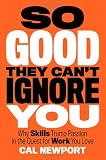
So Good They Can't Ignore You: Why Skills Trump Passion in the Quest for Work You Love


In my travels and interstitial time, I have listened to more than a couple podcasts with Cal Newport as a guest...


Here are just three:

1. ON RICH ROLL's PODCAST
EPISODE 447
CAL NEWPORT ON DIGITAL MINIMALISM: WHY FOCUS IS THE NEW SUPERPOWER


“Simply put, humans are not wired to be constantly wired.”
CAL NEWPORT

It’s become increasingly harder to just put the phone down. Because the latest apps and digital platforms are specifically designed to addict, we have become slaves to their irresistible allure.
Our precious attention is being hijacked. The ability to focus — to concentrate on that which is most meaningful — simply cannot compete with the magnetic pull of our Instagram feed. No longer need anyone ever be bored. Alone with one’s thoughts. Or simply present with one’s self. 
The result is a global epidemic of distraction. A fomenting of loneliness and isolation. And a degradation of our humanity.
The solution isn’t Ludditism. Instead it’s agency. We need not be victims of technology. We have the power to liberate ourselves from the tether of digital dependency. And the freedom it creates isn’t just the salve to what ails us, it’s the gateway to that which we seek most. Meaning. True human connection. And a reconnection with our innate humanity.
Indeed, there is no substitute for real relationships. Boredom is useful. And focus is the new superpower.
Cal Newport is someone who has spent a lot of time thinking deeply about these issues.


2. The Ezra Klein Show
Cal Newport on doing Deep Work and escaping...
84 MINS

APR 18, 2017


Episode Info

I was asked recently to name a book that changed my life. The book I chose was Cal Newport’s “Deep Work,” and for the most literal of reasons: it’s changed how I lived my life. Particularly, it’s led me to stop scheduling morning meetings, and to preserve that time for more sustained, creative work.Which is all to say that I’m a bit obsessed with Newport’s work right now, and especially his account of how the digital environment we inhabit is training us out of concentration and into distraction in ways that are bad for us, bad for our work, and ultimately bad for the world. Most of the conversations on this podcast are how to think about things differently. This one is too, but it’s more importantly about how to do things differently, and why you should do them differently. We discuss..."


3. #188: Digital Minimalism, Cal NewportTen Percent Happier with Dan Harris

    • Mental Health

It's hard to deny our society's increasing dependence on, if not addiction to, email, apps and social media. If we recognize it as a problem, then how do we fix it? Cal Newport is a computer science professor at Georgetown University and the author of the New York Times bestseller: Digital Minimalism: Choosing a Focused Life in a Noisy World. Newport writes about our growing dependency on technology and its negative consequences. From deleting apps on your phone to spending time alone with your thoughts, Newport provides valuable steps to break away from our increasing digital dependency.


Next, I want to read Newport's latest book:
Digital Minimalism: Choosing a Focused Life in a Noisy World


And revisit  Charles Duhigg's book: The Power of Habit: Why We Do What We Do in Life and Business

Wednesday, November 6, 2019

Wise Words from One of My Mentors from One of his Mentors: "You Teach Them"

            Fall trimester of my junior year in high school, I earned a 4 on 6 scale in Mr. Henningsen's American History course. Hoping for a 4.5 or even a 5, I was devastated since my GPA was subpar - once again.

              During my sophomore, I had dug myself a tremendous hole. Frankly, I was fortunate to return to Andover for my junior year after being on academic probation the previous year. Struggling with grief after the loss of my grandfather in December, plus frustrating athletic injuries in soccer and winter track while also breaking my hand in the spring after achieving my goal of making varsity lacrosse, I battled with depression most of my sophomore year. At the end of the spring trimester, I buckled down after realizing how perilous my place at Phillps Academy was - failing most of my classes that midterm. With fear of expulsion, I studied, performing well on all my exams, especially French.

             So, in the fall of my junior year, I returned - determined to excel. After dinner, while many socialized until study hours, my best friend and I would eat quickly and return to the quiet second floor of the library immediately. I knew I had to develop my reading comprehension with note-taking skills, especially for Henningsen's history. Never before did I have so much reading to cover - every single night. With a feeling that I would never know what he may ask in class, I read and wrote notes and reread the notes, but I came up short on test after test. I spent hours on essays, yet they never translated to the grades I had hoped. With time and effort, I learned from my mistakes; however, I earned a 4 in the fall and again another 4 in the winter. I admit that I cried my eyes out to my mother that I will never get into college.
         
             Nevertheless, I admired Mr. Henningsen and sought his approval and respect, so I continued to work. I often wondered if I was smart enough - and certainly felt not good enough in a classroom and school of hard-working, talented over-achievers.

             In the spring, after an arduous year and final exam, I earned my 5 - finally. Truth be told it was one of the few 5s on my transcript. But more importantly, I was proud of his kind words on my year end comment. Mr. Henningsen acknowledged my perseverance and improvement over the course of the year.

           The fall of my senior year, Mr. Henningsen wrote one of my college recommendations. I have no doubt that I would not have been accepted early to the University of Pennsylvania without his letter of recommendation.

             And more importantly, perhaps, I would not appreciate reading and writing in the way I do now. I know that I would not be a teacher without his example. When I am sick and tired and frustrated at times as a teacher, I remember his patience and support.

             Watching these videos brings me back to his classroom, and I "teach them" like he taught me.

New York Campaign Celebration: Vic Henningsen '69, P'01, '05 from Phillips Academy on Vimeo.
Vic Henningsen instructor in history and social sciences spoke at the December 2010 campaign event in New York City.


Baccalaureate 2013 - Vic Henningsen from The Polk-Lillard Center on Vimeo.
Phillips Academy Andover Baccalaureate 2013, reflections from faculty: Victor Henningsen


Vic Henningsen Tribute by Ross Bendetson '13 from Phillips Academy on Vimeo.

Perspectives on Leadership from Phillips Academy on Vimeo.

"Hundreds of alumni returned to campus April 27 to honor Barbara Chase, including trustee president emeritus David Underwood ’54 and his successor Oscar Tang ’56. Making the most of this reunion and tapping the collective wisdom of the three leaders, the Academy hosted a panel discussion, “Perspectives in Leadership.” Faculty, staff, alumni, and parents filled Tang Theatre Friday evening for a Q&A session moderated by Vic Henningsen ’69, instructor in history and social science."

Thursday, October 24, 2019

Content Consumption: Garbage In, Garbage Out

Today I asked students a few questions...

Journal: 10/23/19

1. What is going on in the world today?

2. What's "trending"?

3. What are the top news stories?

4. What podcasts, news, TV, videos, etc. are you watching/listening to?

5. What are you reading?

6. What worries you? What problem would you like to solve in the world?


Consider this....


I played a clip on the reading habits of Bill Gates
from Inside Bill's Brain: Decoding Bill Gates:
Documentary on Netflix (Start at minute 18).


When I think of Bill Gates, I think of my dad who started his career in computers at Honeywell - owned a couple manufacturing companies and a bottle water company - and ended his career with computers and information systems in Cuyahoga County. He once said, "I wonder if I just stuck with computers, I could have been like Bill Gates."

As a programmer and father, he would often say, "Garbage in, garbage out." 

If we were watching bad television, he would be upset with us for wasting our time and not learning. He was always reading a book, the newspapers, and watched the nightly news plus 60 Minutes every Sunday evening.

Remember we are creatures of habit. How are you developing a reading habit?

How does reading help you develop your "Habits of Mind"?

Consider this book.

Thursday, September 19, 2019

TED Talk Spoiler: Checklist Manifesto


"Our medical systems are broken. Doctors are capable of extraordinary (and expensive) treatments, but they are losing their core focus: actually treating people. Doctor and writer Atul Gawande suggests we take a step back and look at new ways to do medicine -- with fewer cowboys and more pit crews."


The 2012 TED Talk concludes with the final thoughts:

Just using a checklist requires you to embrace different values from the ones we've had, like humility, discipline, teamwork. This is the opposite of what we were built on: independence, self-sufficiency, autonomy.

I met an actual cowboy, by the way. I asked him, what was it like to actually herd a thousand cattle across hundreds of miles? How did you do that? And he said, "We have the cowboys stationed at distinct places all around." They communicate electronically constantly, and they have protocols and checklists for how they handle everything -- (Laughter) -- from bad weather to emergencies or inoculations for the cattle. Even the cowboys are pit crews now. And it seemed like time that we become that way ourselves.

Making systems work is the great task of my generation of physicians and scientists. But I would go further and say that making systems work, whether in health care, education, climate change, making a pathway out of poverty, is the great task of our generation as a whole. In every field, knowledge has exploded, but it has brought complexity, it has brought specialization. And we've come to a place where we have no choice but to recognize, as individualistic as we want to be, complexity requires group success. We all need to be pit crews now.


Wednesday, September 18, 2019

David Foster Wallace on a "Real Education" and our "Default Setting"


In his 2005 Commencement Address at Kenyon College, you may recall that David Foster Wallace spoke about our "default setting" as a metaphor for our "unconscious" thinking - and our real education is to be aware.

With humility, he introduces this "default setting" as self-centeredness that is natural and understandable in this paragraph:

Here is just one example of the total wrongness of something I tend to be automatically sure of: everything in my own immediate experience supports my deep belief that I am the absolute centre of the universe; the realest, most vivid and important person in existence. We rarely think about this sort of natural, basic self-centredness because it’s so socially repulsive. But it’s pretty much the same for all of us. It is our default setting, hard-wired into our boards at birth. Think about it: there is no experience you have had that you are not the absolute centre of. The world as you experience it is there in front of YOU or behind YOU, to the left or right of YOU, on YOUR TV or YOUR monitor. And so on. Other people’s thoughts and feelings have to be communicated to you somehow, but your own are so immediate, urgent, real.
When a baby cries, the baby is fed or changed - the baby learns how to receive attention - and gets what it wants - training parents to provide comfort, food, or a clean diaper.

Wallace concludes - that not much may change for many people - you can survive and be relatively successful, especially in our American culture today.


And the so-called real world will not discourage you from operating on your default settings, because the so-called real world of men and money and power hums merrily along in a pool of fear and anger and frustration and craving and worship of self. Our own present culture has harnessed these forces in ways that have yielded extraordinary wealth and comfort and personal freedom. The freedom all to be lords of our tiny skull-sized kingdoms, alone at the centre of all creation. This kind of freedom has much to recommend it. But of course there are all different kinds of freedom, and the kind that is most precious you will not hear much talk about much in the great outside world of wanting and achieving…. The really important kind of freedom involves attention and awareness and discipline, and being able truly to care about other people and to sacrifice for them over and over in myriad petty, unsexy ways every day.

That is real freedom. That is being educated, and understanding how to think. The alternative is unconsciousness, the default setting, the rat race, the constant gnawing sense of having had, and lost, some infinite thing.


Some day, you may wake up and ask yourself, "Now what?"
That may be a midlife crisis after being "successful" or achieving a goal. What's really important?
Money? Power? Fame?

Significance? Connection? Legacy?


Challenge Your Default - Professor Adam Grant

You may remember David Foster Wallace talking about "default settings" as unconscious living - oblivious to freedom of choice and how to think.


Here's a TED Talk by Adam Grant - Professor at Penn's Wharton Business School that explains how our default browser may indicate more than we may realize.

Consider this metaphorically.


From TED 2016:

How do creative people come up with great ideas? Organizational psychologist Adam Grant studies "originals": thinkers who dream up new ideas and take action to put them into the world. In this talk, learn three unexpected habits of originals -- including embracing failure. "The greatest originals are the ones who fail the most, because they're the ones who try the most," Grant says. "You need a lot of bad ideas in order to get a few good ones."

Excerpt:

09:20

Now, in my research, I discovered there are two different kinds of doubt. There's self-doubt and idea doubt. Self-doubt is paralyzing. It leads you to freeze. But idea doubt is energizing. It motivates you to test, to experiment, to refine, just like MLK did. And so the key to being original is just a simple thing of avoiding the leap from step three to step four. Instead of saying, "I'm crap," you say, "The first few drafts are always crap, and I'm just not there yet." So how do you get there? Well, there's a clue, it turns out, in the Internet browser that you use. We can predict your job performance and your commitment just by knowing what web browser you use. Now, some of you are not going to like the results of this study --

10:06 (Laughter)

10:08

But there is good evidence that Firefox and Chrome users significantly outperform Internet Explorer and Safari users. Yes.

10:17 (Applause)

10:19

They also stay in their jobs 15 percent longer, by the way. Why? It's not a technical advantage. The four browser groups on average have similar typing speed and they also have similar levels of computer knowledge. It's about how you got the browser. Because if you use Internet Explorer or Safari, those came preinstalled on your computer, and you accepted the default option that was handed to you. If you wanted Firefox or Chrome, you had to doubt the default and ask, is there a different option out there, and then be a little resourceful and download a new browser. So people hear about this study and they're like, "Great, if I want to get better at my job, I just need to upgrade my browser?"

10:57 (Laughter)

10:58

No, it's about being the kind of person who takes the initiative to doubt the default and look for a better option. And if you do that well, you will open yourself up to the opposite of déjà vu. There's a name for it. It's called vuja de.


“It's okay not to know all the answers. It's better to admit our ignorance than to believe answers that might be wrong. Pretending to know everything, closes the door to finding out what's really there.”
― Neil deGrasse Tyson

Tuesday, September 10, 2019

Art and Icarus

Henri Matisse's Icarus


Plate VIII from the illustrated book, "Jazz",1947  French This bold and playful image is one of twenty plates Matisse created to illustrate his groundbreaking book "Jazz." The illustrations derive from maquettes of cut and pasted colored papers, which were then printed using a stencil technique known as "pochoir."

 Here, the mythological figure Icarus is presented in a simplified form floating against a royal blue nighttime sky. Matisse's flat, abstracted forms and large areas of pure color marked an important change in the direction of his later work and ultimately influenced "hard-edge" artists of the 1960s like Ellsworth Kelly and Al Held


Read this article: