obrienk

Thursday, September 11, 2014

Shifting the Paradigm: Canvas Beyond the Classroom - for Teams, Clubs, Activities, Committees, Professional Development, Community Education 


Building on the Global Online Academy experience, we can create an ongoing professional development course by faculty for faculty. 

All schools are busy places. It's difficult to find time to meet and share in a meaningful and productive way.

In GOA courses, we talked about asynchronous teaching and learning. When I think of the scheduling task force and other initiatives - especially the GOA cohort - we can collaborate and share via Canvas with ongoing asynchronous discussions.

When it comes to technology, it's not about getting on the bus.
But rather sharing what works - as well as what hasn't - as we try new lessons and technologies.

We are all on our respective places on the path.
Let's share where we are on the path when it comes to technology.
Through Canvas, we create conversations both online and in person. 


What is Canvas? What is an LMS? 


With Canvas, we could host meetings like the innovation committee groups, offering more input, dialog, and greater transparency.

With so many initiatives on the drawing board, the faculty can see the big picture where we are and how we can help.

For instance...

JTerm 
    - course descriptions 
    - lessons in project-based learning
    - integration of technology - best practices
    - final projects 

1:1 program
    - LMS integration
    - 21st century pedagogy
    - best practice possibilities 

LMS selection committee

Schedule Review committee
Other Committees - discussions, video conference
Points task force and other task forces 

GOA for Faculty
GOA for Students
CGI

I can also envision Canvas courses for...
Advisory - like a MOOC - course info by grade - curated by dean - integrated with...
  1. Advisors
  2. College counseling - course begins freshman year
  3. Academic Support - Learning specialists
  4. Student Health and Wellness
  5. Library - leading student digital literacy course
Other possibilities: 
Clubs and student groups - courses that have content and calendars

Athletic teams - communication, schedule, playbooks, videos

Jterm prep and courses.  

And ONE clear calendar for everyone - think of Canvas as an institution's calendar - for everyone and everything.

Yet each individual would have a To-Do list - and upcoming agenda. 

Canvas is like a clearinghouse - and a switchboard for a school.

Please read the Canvas press releases - and the news - not just US colleges - but worldwide schools are choosing Canvas - and major corporations are using Canvas for professional development. 

Canvas open source paradigm and integration with major publishers and startups will allow it to evolve exponentially. The more I read about Canvas...and use Canvas for my classes...

This is the LMS we have been waiting for  - Canvas is revolutionary.

A game-changer that will transform education.

Let's all collaborate.

Monday, September 1, 2014

The Sting: Old School Academic Policies in a Digital World

We are setting up our students to fail, to cheat, and to steal when we pretend the Internet does not exist.

Plagiarism in a world of remix, sampling, remakes, and Wikipedia can be confusing to children to say the least. They are digital natives. We are not.

I can write another long post, or share another anecdote, but recently I have curated content that I must share...

1. To begin, Flipboard should be shared with all teachers - more on that later. I curated a magazine on Flipboard about Plagiarism and found Beg, Borrow, Steal by Marcelle McGhee - and more!

2. Take the time to listen to NPR's TED Radio Hour "What Is Original?

3. From PBS: Published on Oct 3, 2013
Creativity has always been essential for our cultural growth, but there are still many misconceptions about this elusive process. Not the left-brain/right-brain binary that we've come to believe, being creative is considerably more complex, and requires a nuanced understanding of ourself and others. Being a powerful creative person involves letting go of preconceived notions of what an artist is, and discovering and inventing new processes that yield great ideas. Most importantly, creators must push forward, whether the light bulb illuminates or not.


4. From NYTimes via Brainpickings plus more Brainpickings on Mark Twain:


5. When academic policies are debated, I wondered what my alma mater does...and I found a pdf version of Andover's Blue Book. What I like most is the tone by beginning with expectations - and how honesty is foundational to a community; then, the policy acknowledges: 
"All scholarship builds upon the ideas and information of others; the honest person makes clear in written work exactly what the source of any borrowed information or idea is, whether it be library materials, the Internet, classmates, or family members." 
There is no scholarship without reading the ideas of others. It doesn't say don't use the Internet. 
It doesn't mention reading guides. It doesn't say be original. It doesn't don't talk to anyone. It simply says honesty is vital and the honest person gives proper credit where credit is due. 


In my opinion, reading guides are much ado about nothing. They give the basics. Most students would rather read the book, if they have time. They can help weaker students and he/she need not feel shame about using them. And when you say DON'T - some students will read them for the sake of rebellion. 

We should focus on teaching the importance of honesty, and how to become digital citizens (proper citation in a digital world, the consequences of plagiarism, etc). 

While students may be digital natives, they must learn digital citizenship. Where else are they going to learn these lessons? College is too late.

At the very least, we must end the denial about the Internet and let go of the nostalgia for the primacy of physical books (and that's really tough for me to write as a self-confessed hoarder of books). 

Then, both teacher and student can learn in an environment of integrity.

Saturday, August 30, 2014

What did Sisyphus do? A student's question that changed the way I think about teaching.

Sisyphus used Spark Notes.


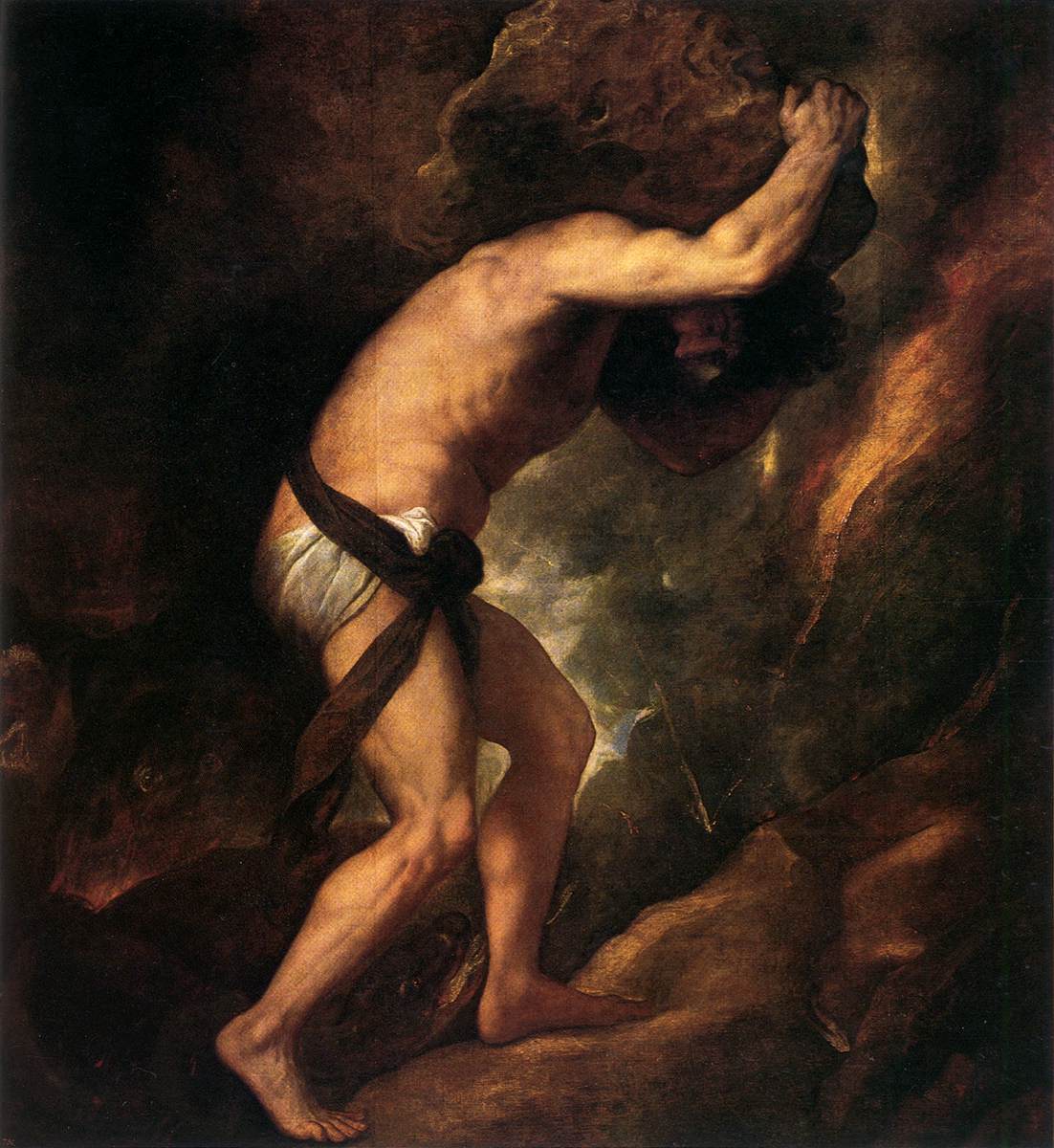
Sisyphus by Titian 

In my second year of teaching Homer's epic poem, The Odyssey, a freshman asked me, "What did Sisyphus do to deserve his fate?"

I froze. Sixteen sets of eyes looked to me. I had never been the sage on the stage, yet I once knew the answer, but I had forgotten - confusing Sisyphus with Tityus and Tantalus
(Click the links for the answers.)

So like any good teacher, I redirected the question.

"Hey, what are you doing, Mihir? Put your hands up." 

Busted. His smartphone aglow on his lap. 
I pride myself on catching students on their phones in class.

Sheepishly, a grin came across his face...

"I was just reading on Wikipedia. I was curious what Sisyphus had done." 

"You don't know the answer" was the unspoken remark that everyone heard.

His hands were still held up. So I relented. 

"Well, what did Sisyphus do?" 

And he read us the definition and we moved on - enlightened. 

In the moment, I laughed at myself, yet I never forgot that question. 

Kids by nature are curious, but the way we play the game of school crushes that curiosity. We say...

Read the book.
Think for yourself. Come up with your own ideas. 
Don't use the internet. 

But why are we pushing our own boulder up the hill in teaching? 

We still pretend the internet does not exist in the English classroom. 

When we talk of integrity and say don't use the internet, we are not living in the reality of 2014. 

We are wired to Google it as teachers - yet we tell our students - you can't do the same. We know the word for that and teenagers are keen to it - hypocrisy. 

After I surf the web to answer a question, I am smarter from the experience. I've made connections with the text. 
I understand references, vocabulary, biography, and history.
I've learned (and here I am writing and sharing what I've learned, so I don't forget). 

We demonize online reading aids because they summarize the plot and analyze passages for students (and alas, not that well). We think that they ruin the reading experience - they are spoilers. 

Yet we forget that only in a second reading can we see the significant details of foreshadowing and symbolism and start to see thematic through-lines. 

We forget how busy our students are and they pressure they are under to do it all. 

But we play a game, a charade of control, and we want to see who's innately intelligent, anticipating what comes next in the novel.

So we tend test and quiz on plot - but we call it close reading. 

As teachers, we even read Spark Notes so that we make sure not to use passages or questions that can be answered by just reading Spark Notes, so we devolve into a world of double think and suspicion of our students, and downright anger that the internet exists. 

Let's end the gotcha quizzes that keep kids honest - the irony.

That's not teaching. That's testing and grading - in a game that has no integrity or true learning. 

I'm tired of pushing the boulder up the hill.

Then again...


Excerpt from Book 11 of The Odyssey

from MIT's downloadable Trans. by Samuel Butler
"After him I saw huge Orion in a meadow full of asphodel driving the ghosts of the wild beasts that he had killed upon the mountains, and he had a great bronze club in his hand, unbreakable for ever and ever.  
"And I saw Tityus son of Gaia stretched upon the plain and covering some nine acres of ground. Two vultures on either side of him were digging their beaks into his liver, and he kept on trying to beat them off with his hands, but could not; for he had violated Jove's mistress Leto as she was going through Panopeus on her way to Pytho.  
"I saw also the dreadful fate of Tantalus, who stood in a lake that reached his chin; he was dying to quench his thirst, but could never reach the water, for whenever the poor creature stooped to drink, it dried up and vanished, so that there was nothing but dry ground- parched by the spite of heaven. There were tall trees, moreover, that shed their fruit over his head- pears, pomegranates, apples, sweet figs and juicy olives,but whenever the poor creature stretched out his hand to take some, the wind tossed the branches back again to the clouds.  
"And I saw Sisyphus at his endless task raising his prodigious stone with both his hands. With hands and feet he' tried to roll it up to the top of the hill, but always, just before he could roll it over on to the other side, its weight would be too much for him, and the pitiless stone would come thundering down again on to the plain. Then he would begin trying to push it up hill again, and the sweat ran off him and the steam rose after him. 

Interesting name: Artist Franz von Stuck 1920 painting of Sisyphus

Monday, July 7, 2014

9 Words That Will Change Your Life; Daniel Pink Encore

I won't keep you in suspense, or make you watch the video below....

Here's the 9 words from Northwestern University Professor Charlie Yarnoff to Daniel Pink in "Writing the Essay" that changed his life - and it can change yours too: 
"Sometimes you have to write to figure it out." 
Prior to hearing this advice, my goal this summer was to write more - write about teaching, coaching, and living.

Not outlining or planning on where the writing would take me, but the important act is the process of writing.

Note: I refrain from using the term blog. Unfortunately blogging has such negative connotations. Just the sound of the word almost suggests an onomatopoeia...blog, blob, blah, blah, blah.

So when I heard this recent address by Daniel Pink on my drive home to Cleveland from Philly, I was reminded of a profound truth: do your thinking in writing - one that I have preached to freshmen and seniors alike.

Yet as a teacher, I feel more like that frustrated writer in the summer that talks a good game during the school year, but let's be honest, I don't write anymore - and haven't written much since grad school...

At the moment, I am in bed, ready to go to sleep, but I type away. Why?

Writers write.

When I heard this speech half way through my 400 mile journey home, I felt less like a heroic Odysseus but more like the prodigal son. Pink's advice to the class of 2014 hit a nerve with me. He talked of successful people and the process of writing an essay as metaphor for life:

Why? Because they lived to figure it out. At some point in their lives, they realized that carefully crafted plans, like meticulously outlined essays, often don’t hold up. And tweaking the topic sentences, or rearranging the subsections, isn’t enough. 
Sometimes the only way to discover who you are, or what life you should lead, is to do less planning and more living. To burst the double bubble of comfort and convention and just do stuff. Even if you don’t know precisely where it’s going to lead, because you don’t know precisely where it’s going to lead. 
Now this might sound risky. And you know what? It is. It’s really risky. But the greater risk is to choose false certainty over genuine ambiguity. The greater risk is to fear failure more than mediocrity. The greater risk is to pursue a path only because it’s the first path you decided to pursue. 
With miles of PA Turnpike ahead of me, I reflected on my life and the turns I have taken and the comfort and convention that I had left after eight years of teaching at a boarding school near home. After a year of transition at a day school, living in the city and commuting to the suburbs, I had plenty to think about on my drive.

When I was a 15 year old student on full financial aid at Andover, I returned home over the holidays and visited my old elementary school. In chatting with my former first grade teacher, she asked me what I wanted to be when I grew up? I shrugged that I might like to be a teacher at a boarding school because of the admiration I had for my teachers at Andover. I couldn't believe it even after I said it, but she was insistent that's what I would do someday. And I resisted this fate for four years after college. However, to be candid, and really honest with even myself, I have moments of doubt where I wonder if I pursued a path only because it's the first path... one that I knew well - the only path at 15 that I knew.

Around that time, when my dad's business collapsed and our house ended up in foreclosure for a time and a period where my parents made ends meet on food stamps, my mom, often at her wits end with stress, would say repeatedly to my two brothers and me:
"Be a doctor or a lawyer, but never be a businessman like your father." 
I never forgot that line. And I learned business equaled risk.

My first year in college, after a brief six week stint in Chemistry, and struggles with history paper deadlines, I concluded neither medicine nor law were in the cards. English courses inspired me and I read all that I could...thinking someday I will teach, but really... the dream was to write.
Novels. Screenplays. Short stories. Even poetry.

After losing my brother Conor when I was 26, I soon settled down to teach after living in Baltimore, NYC, and Miami.

Now at 40, I enter my thirteenth year of teaching. I am amazed how fast time moves and the years blur together. I am grateful for the purpose, connection, and meaning I've experienced as a teacher. Teaching has allowed me to serve others, and I feel I've made a difference.

But I recognize that teaching and coaching may be playing it safe, living in my comfort zone.

After college, I am thankful I lived in NYC and explored life for a few years after college, but in a way, I feel I have always been in school. As a teacher, there's relative job security, steady paycheck, and bonus: summer's off.

Don't get me wrong - I love what I do - but before bed, and during long drives, I confess that I still wonder what I want to be when I grow up.
What risks have I not taken?
What do I regret?
What do I regret not doing? 
These questions can haunt many of us, if not all of us.

I leave them unanswered because I am not the writer that I dreamed of being. Not yet at least.
I am not Daniel Pink - and for as much as I admire him, I envy him. I'd love to write in a garage like his all day. But part of me knows, I would miss teaching. Who says I can't do both?

In the end, I must say thank you, Daniel Pink - for sharing Professor Yarnoff's advice and more importantly inspiring me to write - and take risks - even if it's so little as publishing a blog that I am afraid to post, knowing full well that no one reads this but me - I have seen my stats ;)

Good night.

Here's to writing, and figuring it out. You never know.


Full transcript on idonethis.com

Footnotes:

Pink's Poetry professor Dennis Brutus, who gave him an A- if he promised never to write poetry again. 

Sadly, Professor Sheila Schwartz had passed away in 2008.

And look what I just found: Charlie Yarnoff's brilliant Grading Criteria for a Reflective Essay
          An “A” paper:
•    Has a well-focused main idea that is developed throughout the essay.
•    Is logically organized so that readers follow the development of the main idea easily.
•    Clearly explains the underlying premise and key points.
•    Addresses major questions and counter-arguments that readers are likely to raise.
•    Has well-focused paragraphs with clear topic sentences.
•    Offers relevant quotes and paraphrases to support main points.  Accurate source citations are provided.
•    Has the relatively informal, personal style of a reflective essay.
•    Has an introduction that engages the audience and establishes the paper’s focus.
•    Has a conclusion that provokes readers to keep thinking about the main idea.
•    Has sentences that are concise, direct, appropriately varied in structure, and mechanically correct.

Thursday, July 3, 2014

How Do We Teach Poetry? "Sell It!" Says Daniel Pink

When students (and most people) think of poetry, they tend to hear...


Teachers, let's face it: how we were taught poetry when we were in school influences our association with poetry.

As teachers, do we inspire poets and a life-long love of poetry?

Perhaps, if we are inspired, we hope that our passion can make a difference.

Borrowing from Middlebury Professor Jay Parini, I ask the question, "Does poetry matter?"

And inspired by Parini, I have argued "Why Poetry Matters".

But I realize that I tend to teach from my point of view, and I do not see (or hear) poetry through the eyes (and ears) of my students.

For a few years now, I share with my students a poem from one of my favorite poets...

BY BILLY COLLINS
I ask them to take a poem   
and hold it up to the light   
like a color slide

or press an ear against its hive.

I say drop a mouse into a poem   
and watch him probe his way out,

or walk inside the poem’s room   
and feel the walls for a light switch.

I want them to waterski   
across the surface of a poem
waving at the author’s name on the shore.

But all they want to do
is tie the poem to a chair with rope   
and torture a confession out of it.

They begin beating it with a hose   
to find out what it really means.


After reading this poem, I'd be a hypocrite in class, and we would tie this poem to the chair and over analyze it.

Then I would play a favorite reading by Billy Collins with the expectation that students would like poetry and Billy Collins by hearing the poet's voice - yet that would often backfire. The laugh track would cue them to the irony, but they'd complain about the "boring" tone and not appreciate the nostalgia or the ironic humor.


Instead of enjoying poetry, students wonder if this will be on the test. 

Their attention wanders to thoughts of their math test next period, or their Spanish quiz that they may have failed last period.

In a bottom-line, test-driven culture, we can no longer manipulate students to jump through hoops, especially if it's not on the test. 
Poetry is difficult to test - yes, you can identify figurative language with multiple choice questions or write essays that paraphrase analysis found online... 
Plus how do we assess poems written by students? Do we give points for a simile? Do we require punctuation?

We have to move students and shift mindsets, including our own. Poetry matters if students show us how it matters to them.

As a teacher at a new school, I was the new guy in a new culture and once again I had to rethink how I taught (and motivated) students. I found extrinsic incentives do not inspire critical thinking that is required in reading and writing.

Addicted to TED talks, I discovered and meditated on the ideas of Daniel Pink:


A summary of Daniel Pink's DRIVE: When it comes to motivation, there’s a gap between what science knows and what business does. Our current business operating system–which is built around external, carrot-and-stick motivators–doesn’t work and often does harm. We need an upgrade. And the science shows the way. This new approach has three essential elements:
1. Autonomy – the desire to direct our own lives.
2. Mastery — the urge to get better and better at something that matters. 
3. Purpose — the yearning to do what we do in the service of something larger than ourselves.


For more, check out Daniel Pink's full TED talk.

Recently, I started reading and thinking about his most recent book - To Sell Is Human.

Now before we grow too cynical about teachers as salesperson, consider this argument by Pink:
Here’s the thing. I think that educators are in sales. Essentially what you are doing is making an exchange with your class. You’re saying, give me your attention. In exchange, I’ll give you something else. The cash register is not ringing. It’s not denominated in dollars or cents or euros, but it is a form of sales in a way. It is an exchange...Read More
Watch this:


As teachers, we don't like to think of ourselves being in sales.
But we are. When we hear the word "sales" we cringe with the connotations...

Yet everyday we sell our subjects to students at school; however, the game has changed with the internet. Our students have changed.

We no longer hold the keys to knowledge - lectures, content, lessons - all readily available at their fingertips.

As teachers, what is our role now? 

Motivators, coaches, facilitators, guides, curators, etc.


According to Daniel Pink it's the New ABC's of attunement, buoyancy, and clarity, he writes:

1. PULL UP A CHAIR. (ATTUNEMENT) 
If you’re preparing a lesson plan, an empty chair can remind you to see things from your students’ perspective. Attuning yourself to others – exiting your own perspective and entering theirs – is essential to moving others. One smart, easy, and effective way to get inside people’s heads is to climb into their chairs.

2. SEND YOURSELF A REJECTION LETTER. (BUOYANCY) 
More important, by articulating the reasons for turning you down, the letter might reveal soft spots in what you’re presenting, which you can then work to strengthen.

3. FIND THE ONE PERCENT. (CLARITY) 
Instead, think about the essence of what you’re exploring – the one percent that gives life to the other ninety-nine. Understanding that one percent, and being able to explain it to others, is the hallmark of strong minds... read more.

So now when I think of teaching a poetry lesson, I put myself in a student's chair...
and I think what does she or he like to do when asked a question: Google search. 

Why not foster intellectual curiosity? 

The fun in learning is the inquiry, discovery, and sharing what you find interesting. 

This past year, I had my freshmen explore the internet, research, write poems, and share what they learned about poetry and poems. 
Attunement and Autonomy.

In the future, I will have them write peer comments on their work - and then self-assess their learning, yet they must be more critical than complimentary in their self-assessment. Explain the thought process behind the final product. They know where their own holes are - and how much time they worked on it. As friends, peers are often too kind to point them out. Through self-assessment, students criticize areas of weakness in order to make them a future strength.  
Buoyancy and Mastery. 

If students find their own examples and write their own poems, there is clarity to poetry. 
If they share their discoveries and poems with others, especially outside their class, there's writing for a greater purpose than a grade - remember the purpose of writing is for an audience. I believe students are more concerned with impressing their peers than impressing me as the teacher. Leverage positive peer pressure to produce poetry.
Clarity and Purpose.


Selling a Sonnet Assignment; Make Poetry Personal: 
  1. Define and explain: Sonnet
  2. Find a sonnet that you wish to give to an individual, perhaps a friend or family member.
  3. Write a sonnet - explain why you are giving your individual this sonnet.
  4. Record your sonnet. (Try iMovie or vocaroo.com or other online voice recorders). 
  5. Visit your classmates blogs and comment on their posts. 
  6. Post what you learned about sonnets to your blog - reflect on the learning process of finding, sharing, and writing about sonnets. 
Questions:

What is a sonnet?
Why share a sonnet?
Who writes sonnets?
Why write a sonnet?
How do you read a sonnet?
What did you learn through this assignment?

The more open-ended the better in my opinion to encourage creativity, but being vague with assignments can create anxiety - how do I get an A? Thus...

How you get an A:
Show us what you learned. 
Hit the established deadlines. 
On a scale of 1 to 10, consider where your work stands in relation to the work of  your peers.
Self-assess: what grade do you believe you earned? Make a case. 


Depending on the grade level of students,  I would give students a couple days or a week to complete this assignment. I like to use some classroom time, but not the full period. I like to give mini-lessons (on other fronts:  grammar, vocab, reading other poems, etc.) and allow time for blogging and creative writing to evolve and even percolate on the back burner so students can produce work they are proud of, while reminding them:
“Poems are never finished - just abandoned.” ― Paul ValĂ©ry  

Same can be said for blog posts...

As teachers, we need to shift our focus to 21st century skills. We need to understand how different our students are as digital natives. As a 40 year old teacher, I'm a digital immigrant that must assimilate in order to relate to my students. The internet and smartphones exist. How do we embrace this fact? 

How do we as teachers motivate and inspire our students in this new world? 

Whether it be poetry or coding, let them show us what they've learned as we foster intellectual curiosity in our teaching. 

Monday, June 23, 2014

Hacking Education: A Mindset that Embraces Change

This past spring trimester, Phillips Academy's Head of School John Palfrey taught a compelling course called "Hacking Andover; an Experiment in Education in the Digital Age."

It connects in many ways with my first course at Global Online Academy.

Having graduated from Andover in 1992, I continue to be inspired by this special school.
I wish I could have taken this course!

Assignments included a playlist on Youtube:


Students also published content to a variety of social media outlets: Wordpress page, Facebook, Twitter, and Google+.

Plus they had a field trip to MIT.

A student's final argument that echoes Ken Robinson's thoughts on divergent thinking as well as how and why to assimilate technology into the classroom:


This course also reminds me of a video of my history teacher from Andover, Victor Henningsen.
I watch it from time to time, most recently this winter during a snow day, to remind me of my purpose as a teacher.