obrienk

Saturday, December 1, 2012

Detention: Thinking Out Loud with Social Media

So it's Saturday night, and I'm in detention. Not quite a John Hughes film like The Breakfast Club. 

(I include the trailer for students that haven't seen such '80s classic films)


To clarify, I am not serving detention. I monitor detention that runs from 7:45 to 10:30pm. The students have cut class or required work to make up. Some may have skipped one too many sit-down meals or assemblies. The list is relatively short - seven kids - in a boarding school of about 400 - not bad.

Their eyes are fixed on laptops and ipads with earbuds secured. 

One boy falls asleep; after twenty minutes, I tap him on the shoulder and tell him to take a bathroom break and splash a little water on his face. 

Truth be told: many of these students would be doing the same thing in their dorm rooms. The punishment is to sit in uncomfortable chairs in a math classroom under terrible fluorescent lighting. My eyes hurt. 


Meanwhile, I contemplate grading, reading, revising plans for tomorrow's lacrosse clinic, or finishing an overdue course plan for a unique ECHO course this winter entitled: "Teaching Social Media."

(What is an ECHO Course? FYI )

So please allow me to think out loud with you.

Here's the course plan: 

_______
TEACHING SOCIAL MEDIA; Social Media for Social Good

Pre-meeting sign up for Edmodo.com - in-class assignments will be shared on Edmodo.com

Take Edmodo group poll and quiz to see where the 25 students stand in terms of literacy with, and use of, social media.

Hopefully, there will be more than five veteran iMovie editors - and many students with smart phones with HD cameras.

(Exploring possibilities to partner with Mr. Gerber's video editing ECHO that will run simultaneously.)

Week 1:

Watch and Discuss the Fine Brother's viral video:
Teens React to Chilling Cyberbullying Video

"Be With" Exercise - to see one another eye to eye.

Discussion on Integrity: Who am I? An existential crisis in a world of social media.

Review privacy issues on Facebook, Twitter, and Instagram as well as personal exposure on social media.

(Re)introduce Twitter, Pinterest, Google+, and the Class Blog. Create platforms to share and learn.

For some, it will be old hat - for some it will blow their minds; therefore, partner students with a tech savvy mentor.

Things to think about: Who would you like to interview on campus or in Hudson? We will create content for our blog that the admissions office, alumni office, or deans office will likely appreciate - and share with prospective students, alumni, and current students and parents.

Course Projects: Why WRA? What makes WRA special to you? Tell your WRA story.  

Week 2:

Brainstorm in groups; then, go shoot short films on smart phones - one take - no splice editing necessary.

Post to blog - and share via platforms like Facebook, Twitter, Google+.

Brainstorm longer documentaries that will require editing and more story boarding and planning.

HWK: Contact possible individuals to interview on campus and in town.


Week 3: 

Continue to brainstorm and plan in groups; then, go interview individuals on smart phones.

Edit.

Post.

Week 4:


Brainstorm in groups; then, go interview individuals on smart phones.

Edit.

Post.


Week 5:


TBD - Possible field trip one week.


Week 6:


Review and showcase work.

Final discussion.


Conclude with another "Be with" exercise.
________


During the course, we will discuss and share various findings, video clips, and TED Talks.

I hope to have short visits from guest speakers both live and via Skype or Google Hangout. For example, tech savvy faculty, alumni, social media gurus, business owners, non-profit organizers, content producers, writers, etc.

FYI: I've already been tweeting @kob14 relevant links and posts using: #teachingsocialmedia #wraecho

I am guessing the students will teach me more than I can imagine right now; however, I do want to share the idea that who you "Follow" in cyberspace is just as important as it is in the real world.

Technology is a tool - how do we use it responsibly? That's the question.  Imagine if we shifted the mindset from mundane status updates and cyber bullying to social media for social good.

Any feedback would be most appreciated. 

Tuesday, November 27, 2012

Turkey Transition and Novel November

Today, a Taco Tuesday in the dining hall, was the first day back after a generous week off for Thanksgiving break. Long vacations such as these are well-deserved at boarding schools for students and faculty alike.

Yet it's the transition - ramping up to speed - that can be a challenge as November turns to December. It's been called the final sprint to the second marking period and the looming fall exams.

This morning, I was greeted by the sleepy eyes of juniors. This afternoon, the tired seniors showed the effects of disrupted sleep schedules. First days back I tend to tread gently and keep expectations low - the secret to happiness is low expectations according to Barry Schwartz argues in his TED Talk.

Tomorrow will be better as we transition to our second home here at WRA. Expectations are high - and the final push can be intense. Students and faculty up there game in preparation for final essays, projects, and exams. The reward: another long vacation.

However, I appreciate today. Despite the cold grey but dry day, there is an energy and excitement that buzzes on campus as students reconnect like a family reunion with stories and questions, smiles and laughs. I am reminded how special community is - and how special this WRA community is.

_____
And as another birthday passes and November ends - National Novel Writing Month, I think of another year without writing that unfinished novel; however, taking inspiration from Matt Cutts "Try Something New for 30 Days," I will blog for the next 30 days.

Thanks for reading. Here's to writing, again!

So I leave you with a final quote that I found on a new favorite site, brainpickings.org:


The Daily Routines of Famous Writers

by 

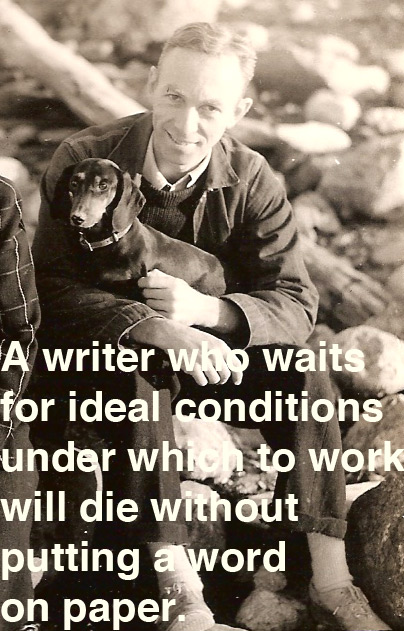
“A writer who waits for ideal conditions under which to work will die without putting a word on paper.” E. B. White


Thursday, August 30, 2012

Dawn Reader: Oops! To err is human--but I don't like to be hum...

Read a great blog from Dr. Dan Dyer - former colleague, prolific reader and writer, and ongoing inspiration to countless students and peers:

Dawn Reader: Oops! To err is human--but I don't like to be hum...: I have spent much of my adult life finding and marking mistakes.  For thirty years I taught English to middle-schoolers (and fifteen more...

Tuesday, August 28, 2012

Dorm Duty and Darth Vader

Ah Freshman! Nothing quite like dorm duty in Wood House, the freshman boys dorm.

I am tempted to email freshman teachers and let them know that they are not assigning enough homework.

This is what I say when freshmen start wandering the halls like animals prowling for food.

I ask if they are finished mastering their foreign language, memorizing their bio book, and annotating all the white space in their Rime of the Ancient Mariner... 
Not to mention - have you completed AP multi-variable calculus?
There is always something to study.  

A door bangs, and I hear pounding, "You can't close your door during study hours."
A door opens, and I hear a bag of cellophane snatched.  More pretzels have been stolen.

Math homework is discussed in another room.

A pretzel thief tiptoes across the hall, seeking more salty snacks.

Another freshman strolls slowly down the hall to get a drink, killing time, then detours into a room not his own.  

They move like Obi-Wan-Kenobi in the orginal Star Wars (Episode IV) - where he sneaks around the Death Star.  

They think I don't notice their wandering and stealth strolling about.
I too am a Jedi, feeling the force.
I guess that makes me Darth Vader, roaming the hall; the Man; the bad guy; the faculty master, playing cop.


Freshman don't realize, yet that little goes unnoticed in a dorm, or at a boarding school.  Eyes and ears are everywhere.  It's a wonderful community where everyone (soon) knows everyone.
But everyone knows everything (sooner than later).
People talk, tweet, and text.
So "live with integrity" is not just part of our mission statement, but sage advice to heed.  

At times, we choose our battles, but we hold them accountable.  Admittedly, the homework is easy at the start, but it will pickup and requests for late lights will soon be frequent (and regularly denied to those who wander).

At 9:45 at the end of study hours, we allow them to have their cellphones - we collect them at 745 when study hours begin.  Two hours without tweets and texts - no notifications vibrating and beeping.   A freshman literally dances and moonwalks down the hall - the joy - the reunion of boy and iPhone.

I notice another wanderer; so I talk with him - a catechism of sorts: questions about his homework in each subject.

A boy down the hall sings a rap song from memory, but can't remember his homework assignments.  A paradigm shift is in order.  I must go.  The music grows louder.

Good night. Duty calls. 


Wednesday, August 22, 2012

Teaching (and writing about) the Poet's Life

A new school year is upon us, and it's time to write again.  The summer months passed far too quickly and my fingers never quite found these keys.  I pecked out emails on my iPhone, but I confess it was a summer of action and travel.  Now I write and reflect.

This fall I am teaching a senior English elective on "The Poet's Life". We will read delve deep into a handful of poets while sharing favorite poems and poets, finding new favorites in the process.  We will follow the advice of Elizabeth Bishop to an aspiring poet circa 1960:

Read a lot of poetry - all the time... Read Campion, Herbert, Pope, Tennyson, Coleridge - anything at all almost that's any good, from the past - until you find out what you really like, by yourself.  Even if you try to imitate it exactly - it will come out quite different.  Then the great poets of our century - Marianne Moore, Auden, Wallace Stevens - and not just 2 or 3 poems, each in anthologies - read ALL of somebody.  

So we began the course with summer reading, Jay Parini's biography of Robert Frost: A Life.  Parini spoke on Brian Lamb's Booknotes on C-SPAN in 1999.  Frost was onsidered the most celebrated American poet from his rise to fame in 1915 to his death in 1963; Parini spent twenty five years researching this biography.  In 2008, Parini taught two teen vandals from Ripton, VT more than a few things about Frost and poetry.

Now, we will read more Frost poems.  We will listen to Frost recordings.  We will watch video ("Stopping by Woods on a Snowy Evening") of him too.  We will take a closer look at "The Road Not Taken" and see if we can find a deeper understanding of the work by knowing the man.  We will also memorize a favorite Frost poem.  We will also create each create a Prezi presentation of one Frost poem.

We will also compare Frost to:
Wallace Stevens - Thirteen Ways of Looking at a Blackbird
Marianne Moore - Poetry

We will also post to a class blog. Check out my first post: http://whypoetrymatters.blogspot.com/


Tuesday, April 24, 2012

Afraid of the dark?

This year's Knight scholar, Ian Cheney screened his documentary The City Dark in the Wilson Lecture Hall.  The film made me think more about light and night pollution than I ever have.  His journey in making this film lead to unexpected discoveries which were fascinating - see the film.  The Q&A with director, writer, and producer Ian Cheney made the experience truly special with excellent questions from students for over half an hour.

Consider this post as a teaser to see the film, rather than a review, and more of a reflection of how it resonated with me.

After the thought-provoking film, I began walking back to my apartment at Wood House and noticed our lighted campus.  I could see down Brickrow from Wilson to the Metcalf Bookstore - a mark of a safe campus, yet felt a new sense of guilt for the generous light from which one could easily read a book.  I felt nostalgic for my first couple years where there were fewer lampposts and many more shadows.

A Frost sonnet, "Acquainted with Night," echoed in my head, especially the third line.

I have been one acquainted with the night. I have walked out in rain -- and back in rain. I have outwalked the furthest city light. I have looked down the saddest city lane. I have passed by the watchman on his beat And dropped my eyes, unwilling to explain. I have stood still and stopped the sound of feet When far away an interrupted cry Came over houses from another street, But not to call me back or say good-bye; And further still at an unearthly height, O luminary clock against the sky Proclaimed the time was neither wrong nor right. I have been one acquainted with the night.

So that's what I tried to do, outwalk the furthest campus light.

I headed to the cross country hill.  My eyes noticing lights everywhere,  a pink hue to the clouds, and a scimitar moon - with a star or a possible planet a few inches to the right above the moon.

To be honest, I wish I knew my stars like my father, a sailor, who once navigated by star light in the Virgin Islands.  He had a telescope that as children we played with like a toy, losing parts to his chagrin.

Yet on the hill tonight, in the shadows behind a wall of remaining pine trees, I could still see all ten tennis courts, light near the hocky pond, and distant cellphone towers and truck lights flashing from Interstate 80.

I was sad to see so few stars and more clouds than I should.

I thought of Peter Lee, former physics and astronomy teacher, and his frustration with night pollution.  My first year, seven years ago, on a similar night, I needed a walk before bed, and I came across Peter in the observatory.  It was a memorable experience for me, yet he was disappointed. Forlorn, he said, there used to be more stars to see.

However, alone tonight, I was still reminded of how insignificant I was in the grand scheme of moon and stars and universe and global commerce with trucks rumbling all night across the country, and cell phone messages whirling faster than bats.

I simply stood and wondered.


The paradox of progress - and connection via technology - that disconnects us from nature and darkness.  

The dark.  The fear of the unknown.  The fear of uncertainty.  


I wonder what is next?

No light can tell us that.

Fear not the dark.


http://www.thecitydark.com/#/Trailer


Monday, January 23, 2012

Twitter, Tweeting, Twits: What's the Story?


If you're not a fan of Twitter, this post is for you.  
If you don't get it, you have to watch the TED Talk below.  

Or not, but odds are high that your friends or your students are already on Twitter.

In this 2009 TED TALK, Evan Williams, Twitter founder, speaks of the unexpected uses of Twitter.  It seems like ancient history now, but if you're already on Twitter and tired of mundane updates - you may want to consider the friends you follow...on Twitter.  

Consider the possibilities of real-time mass communication via Twitter, watch this TED Talk.  Maybe then you'll understand last year's historic revolution in Egypt.


Williams is not the most exciting speaker; however, when I watched this talk last year, it made me rethink how one could use Twitter for multiple audiences.  

If you want to follow a social media maven on Twitter, follow former WRA faculty member and graduate, Brendan Schneider @schneiderb.  His blog schneiderb.com offers priceless advice on using social media in independent schools.  He writes, "I use Twitter for three [reasons]: to share information, to connect, and to communicate." 

After "listening" to Brendan's wisdom for a few months on Twitter, we started using Twitter last spring for WRA's lacrosse program, sharing real-time information with players, parents, and alumni @WRALacrosse.  This year, I am sharing information with my English classes @KOBsENGWRA, for student life at WRA, a boarding school @clubsactivities, and as a head coach @CoachOBrienk.  Each has a specific audience that I wish to share, connect, and communicate with in an effective manner.  

On Twitter, like life, it's all about who you follow. For each account, I follow Twitter users that are relevant to each audience and retweet pertinent information. For example for my English classes, I follow @advicetowriters, @newyorker, @grammargirl, @quotes4writers, @oedonline, @poetryfound, @parisreview, @theatlantic - the list goes on.  I have embedded Twitter feeds on each of my blogs (that's another post).  Easily switching accounts on my cell phone, I only read Twitter a couple minutes a day, but I find much to share. (Now, it may seem like I am an ego maniac.  No, I have no aspirations to be a Twitter celeb like Ashton Kutcher.)

But I teach 10th and 11th grade English, serve as a class dean, and lead the boys lacrosse program. When considering the different hats that one wears at a boarding school, it's all about communication.  There's so much information out there...I like to channel information with a discerning eye, and tweet, "Hey, you may find this interesting - or inspiring."  Yes, some information tweeted is even essential.  

Like any technology, it can be abused; however, Twitter is not going away. Students are using it, and more are going to be using it.  My two cents: meet them where they are and teach students how to use Twitter responsibly and effectively.  

My message to students: tweet wisely as you "Share, Connect, Communicate." If your tweets would embarrass you, your parents, or your school, please think again.  Or at the very least, make them private.  Public tweeting means literally anyone in the world can see those tweets.  

Final thought: perhaps, begin by simply "listening" on Twitter
Follow your interests and people that inspire you - and learn more. 

Thanks, Brendan.